Muscles Of The Body
Understanding Muscles

Muscles Of The Body |
|
Muscles Of The BodyContents
• Facts About Muscles |
| Interesting Facts About Muscles
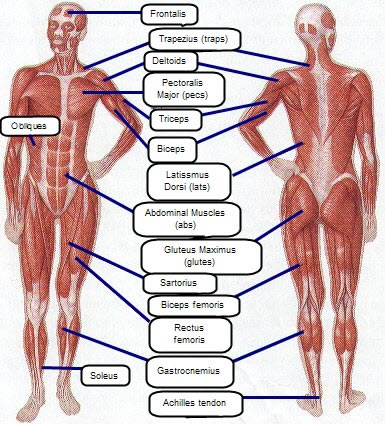
A muscle is a group of elastic tissues. Structure: Muscle tissue is bound together in bundles and contained in a sheath (sometimes called a fascia), the end of which extends to form a tendon that attaches the muscle to other parts of the body (like a bone). Muscle is 75 percent water, 20 percent proteins and 5 percent fats, mineral salts and glycogen. What does it do? A muscle's role is to bring about movement of the body (like walking) or to start an involuntary function (like breathing or a heartbeat). When the muscle contracts, it starts a movement in the surrounding structures (the tendons, ligaments and eventually bones). The muscle contracts in response to a 'message' (nerve stimulus) sent by the brain through a motor nerve. What Muscles Do |
|
|
There are 3 different types of muscles, each with a different structure. |
|
1. Skeletal Muscle
|
Function: These are the muscles that we consciously control e.g. our arms and legs. If we want to walk we do so. Structure: Skeletal muscle has cylindrical cells which make up fibers. Each fiber has several nuclei (multi-nucleated cells) and is surrounded by a sheath (sarcolemma). The muscle will be made from hundreds or thousands of these fibers. The muscle fibers form bundles and they all run in the same direction. Under a microscope voluntary muscle looks stripy. When the muscle contracts the actin filaments slide between the myosin filaments which causes a shortening and thickening of the fibers. |
2. Smooth Muscle
|
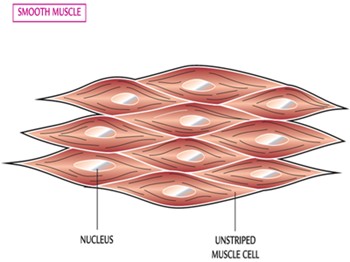
Function: These are the muscles we do not consciously control e.g. those that are found in the walls of blood and lymphatic vessels, in respiratory, digestive and urinary systems. These muscles work automatically whether we want them to or not! Structure: Smooth muscles have spindle-shaped cells with no distinct membrane and only one nucleus. Bundles of the fibers form the muscle we see with the naked eye. |
3. Cardiac Muscle
|
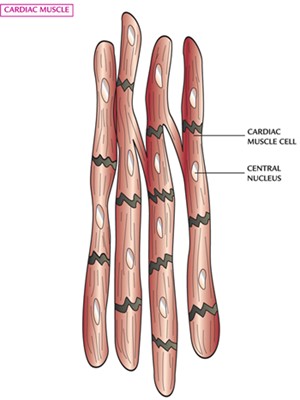
Function: To power the pump action of the heart. Structure: Cardiac muscle only exists in the heart; it is involuntary muscle tissue but its fibers are striated and each cell has one nucleus so, in structure, it resembles skeletal muscle. Each cell or fiber has a nucleus. |
Diseases And Disorders Of The Muscles Atony Atrophy Achilles bursitis Adhesions Frozen shoulder (adhesive capsulitis) Achilles tendonitis Bursitis Fibromyalgia Lumbago Myositis Housemaid's knee Tennis elbow (lateral epicondylitis) Golfer's elbow (medial epicondylitis) Microtrauma Muscle Fatigue Repetitive Strain injury/syndrome Spasm Muscular dystrophy Rupture Shin splints Tetanus The Muscle Symptoms Link To: Nervous system: relies upon nerve impulses to produce a contraction in the muscle. Without nerve stimulus movement would not be possible. Skeletal system: muscles always cross a joint and thus rely on the skeletal system for leverage and movement. Digestive system: nutrition/energy in the form of glucose is received from the digestive system. If it is not immediately used it is converted to glycogen and stored in the muscle fibres for energy production later. Circulatory system: muscles receive oxygen from the vascular and respiratory system. |
Recommended screenings for women: What tests should you have? Back To Homepage: Womens Health Advice |
WOMENS HEALTH ADVICE: ABOUT MUSCLES |
 Unlike some other mammals human babies are not born knowing how to control the voluntary muscles that help us stand and move. When they start to grow they learn to control and co-ordinate muscles in the following order: first the head, then the neck, the shoulders and arms, and only then the lower parts of the body. When a baby finally learns to stand and walk, it has mastered all the muscles of movement because the last ones in the learning process are the pelvis and legs.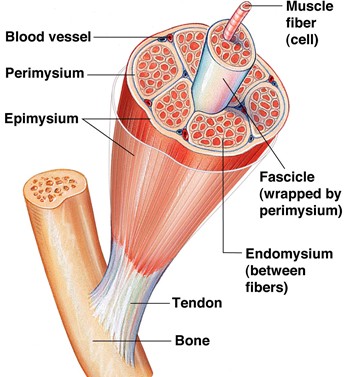
 Other Useful Guides
.gif)